Cathleen Stone Island Outward Bound School and Stone Living Lab Announce Partnership to Advance Climate Literacy
Media contacts: Peter Howe/Katherine Adam, Denterlein, for Stone Living Lab
phowe@denterlein.com
kadam@denterlein.com
press@stonelivinglab.org
617-482-0042
FOR IMMEDIATE RELEASE
BOSTON, February 25, 2026 – Cathleen Stone Island Outward Bound School (CSIOBS) and the UMass Boston Stone Living Lab (SLL) have launched a partnership in collaboration with the Wade Institute for Science Education at Manomet Conservation Sciences to develop a unique coastal resilience learning sequence to enhance experiential learning and climate literacy for students in Boston Public Schools and beyond.
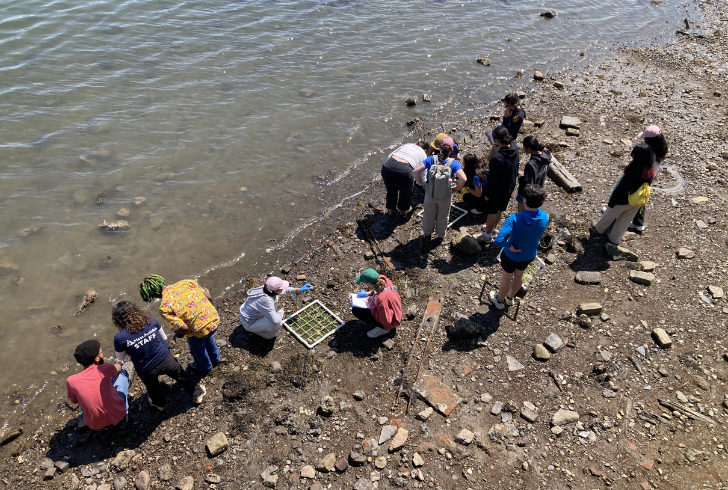
The partnership formalizes the collaboration between CSIOBS and SLL to bring climate resilience research and outdoor learning opportunities to historically marginalized schools and communities. The development of the coastal resilience learning sequence is a key priority for CSIOBS and SLL as they embark on their first year of partnership.
“This partnership allows us to bring real coastal resilience research into classrooms that have historically been excluded from hands‑on environmental learning. By working with Cathleen Stone Island and Manomet, we’re creating learning experiences that help students to see themselves as part of climate solutions,” said Dr. Katherine Dafforn, Director of the Stone Living Lab.
As part of this collaboration, CSIOBS issued a request for proposals in November 2025 for the development of Outdoor Education and the Natural World: An Enhanced Climate Resiliency Learning Sequence for 7th – 9th grade students on Boston Harbor Islands. This plan will create valuable place-based learning opportunities for Boston Public School students who participate in education programming on Cathleen Stone Island (CSI).
The partnership is excited to announce that Manomet was awarded the contract for the development of lesson plans which will link SLL’s coastal resilience research and CSIOBS’ education activities on CSI. Manomet’s Wade Institute will work closely with staff from the Stone Living Lab and CSIOBS to develop and support implementation of a curriculum that aligns with Massachusetts Science and Technology/Engineering Standards.
“In partnership with the Stone Living Lab, the Stone Foundation, and Manomet, we are building on two centuries of empowering young people from low-income communities with immersive experiences on one of Boston Harbor’s most vital islands. By blending practical learning with climate adaptation, we are opening doors to new possibilities for Boston and far beyond. Our mission is to inspire the next generation with a spectrum of career and entrepreneurial opportunities, nurturing their resilience so they can rise as tomorrow’s leaders,” said Sylvia Watts McKinney, CEO and President of Cathleen Stone Island Outward Bound School. Upon implementation of the curriculum, it is expected that field experience programming will reach a total of 2,000+ students each school year.
“We jumped at the opportunity,” said Dr. Molly Jacobs, Vice President for Education at Manomet. “What Cathleen Stone Island and the Stone Living Lab are doing by combining strong place-based science, environmental education, curricular integration with schools, and Outward Bound’s focus on social/emotional growth and leadership is truly innovative, and our team is excited to support it.”
The initiative, which is funded by the James M. and Cathleen D. Stone Foundation, reflects both CSIOBS’s commitment to building stronger, more equitable school communities and SLL’s commitment to engaging local communities in education and outreach programs, bringing its research on nature-based approaches and climate resilience to the forefront of environmental education at Cathleen Stone Island.
“We are thrilled that the groundbreaking research of the Stone Living Lab will soon be woven into the curriculum at Cathleen Stone Island Outward Bound School. This partnership will give BPS students the opportunity to engage in scientific research that matters to their futures and local communities. Outward Bound builds personal resiliency; the Stone Living Lab builds climate resiliency. Together, they offer BPS students something truly unique.” said Sonja Plesset, Executive Director of the James M. and Cathleen D. Stone Foundation.
About Cathleen Stone Island Outward Bound School
Cathleen Stone Island Outward Bound’s core mission is to build stronger, more equitable school communities by delivering free experiential learning programs that boost academic success and foster personal growth. By combining research-based programs in STEM, social-emotional, and challenge-based learning, their programs give students a unique opportunity to build life skills, enhance academic success, and unlock their full potential as future changemakers. Cathleen Stone Island Outward Bound has a 200-year legacy of serving children in Boston and a 47-year partnership with the Boston Public Schools (BPS). They have been an Outward Bound school for over 30 years, and are a proud member of the network of nine Outward Bound Schools throughout the United States.
About the Stone Living Lab
The Stone Living Lab (SLL) is an innovative and collaborative initiative focused on testing and scaling up nature-based approaches to climate adaptation in Boston Harbor and beyond. We are a unique partnership between government agencies and nonprofits: Boston Harbor Now, UMass Boston School for the Environment, the City of Boston, the Massachusetts Department of Conservation and Recreation, the Massachusetts Executive Office of Energy & Environmental Affairs, the National Park Service, and the Massachusett Tribe at Ponkapoag. As a “Living Lab,” we bring research into the real world by engaging scientists and the community in collaborative design and exploration. Our work brings us not only along the coastline of Boston Harbor, but into the water itself and out among the Boston Harbor Islands and other locations. Our areas of focus are research and monitoring, education and engagement, policy innovation, and climate preparedness.
About Manomet Conservation Sciences and the Wade Institute for Science Education at Manomet
Manomet Conservation Sciences uses science, education, and collaboration to strengthen bird migration routes, coastal ecosystems, and working lands and seas across the Western Hemisphere. Manomet’s education team empowers students, teachers, and community members as scientists and environmental stewards by putting tools and resources into their hands and by connecting them to locally important conservation issues. The Wade Institute for Science Education at Manomet is focused on improving science education inside and outside the classroom by connecting teachers and informal educators with science, technology and engineering content expertise, inquiry-based instructional methods, regional STEM resources, and peer learning communities.