Living Seawalls One-year Update
by Daniel Lopez
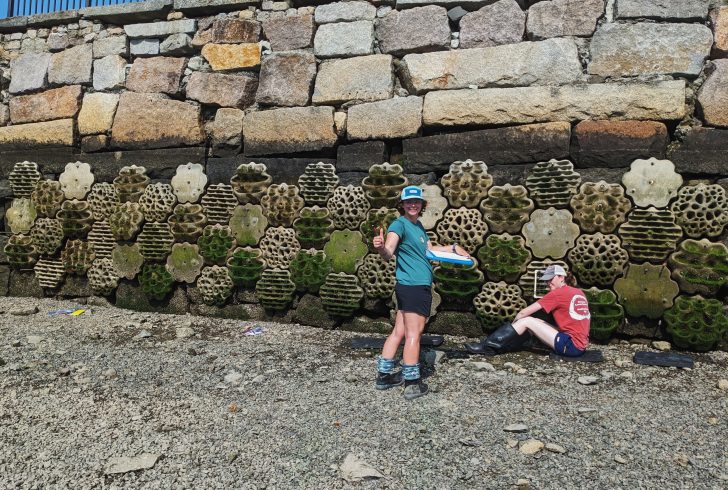
In November of 2024, the Stone Living Lab (SLL) installed its first Living Seawalls panels at two locations in Boston Harbor, Fan Pier in the Seaport District and Condor Street Urban Wild in East Boston. Living Seawalls use 3D printing technology to replicate the pits, crevices and pools of natural rocky shorelines on panels that have been retrofitted on seawalls worldwide. The summer following their installation in Boston, the SLL biological monitoring team led by Jarrett Byrnes conducted biodiversity surveys to assess the marine life choosing to call these Living Seawalls home, as part of SLL’s regular monitoring of this project, with some exciting new residents spotted!
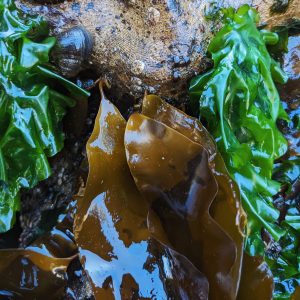
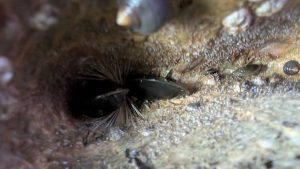
Sugar kelp (left) and blue mussel (right) recruitment on Living Seawalls panels at Fan Pier in Seaport.
The team found exciting recruitment of different seaweed and invertebrate groups on the panels at Fan Pier in Seaport. Preliminary analysis suggests an increase in red algal species cover in comparison to control sites. During surveys, the team also found sugar kelp (Saccharina latissima) and blue mussel (Mytilus edulis) growing in the low intertidal zone and on the Living Seawalls! Mussels and sugar kelp are declining in the Gulf of Maine, seeing juvenile recruitment and their persistence in the seawalls indicate that the panels may be suitable substrates for these at-risk species. The microhabitat features on the panels may provide habitat and protection for these species.
Since both blue mussels and sugar kelp are foundation species, they serve as possible indicators as to what the marine community may look like along these panels. Continued successful recruitment of these species could result in mussel and kelp bed formations, both of which would provide critical habitat and food for a wide range of other species.
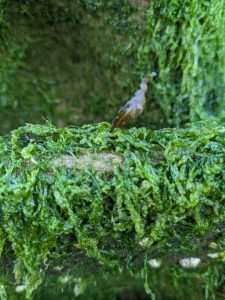
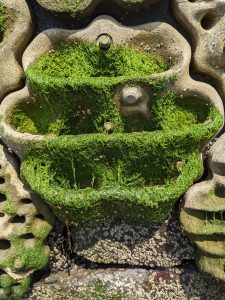
Juvenile green algae growth on Living Seawalls panels at Condor St Urban Wild.
At the Condor Street Urban Wild Living Seawalls installation, there was significant growth of green algae on the panels. This indicates that the Living Seawall installation is exhibiting expected patterns of recruitment within an intertidal ecosystem in Boston Harbor. The team is interested to see whether that pattern will continue over time, with late-successional species establishing themselves on the panels.
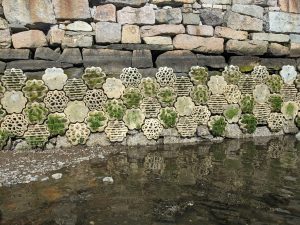
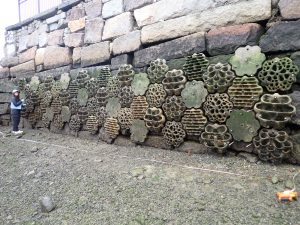
Living Seawalls installation at Condor St Urban Wild after the heatwave in July 2025 (left), and in April 2026 where the panels are showing signs of algae regrowth (right).
However, this drastically changed as the summer progressed. Boston experienced one of its hottest heatwaves in July 2025, with temperatures along the seawall reaching 50 degrees Celsius (around 122 degrees Farenheit). In a matter of weeks, almost all the growth on these panels died off. While disheartening to see, weather events like these provide great opportunities to observe community resilience and recovery in the face of climate change, and whether eco-engineering methods such as living seawalls can help ameliorate the impact. Since the die-off, the monitoring team made it out to the Living Seawalls this spring during a community-organized clean up and observed a good amount of regrowth of green algae on the panels.
Since installation, the panels have supported dynamic and ever-changing biological communities, and offer new insights into how Living Seawalls respond to a changing climate. As our monitoring team heads into another summer sampling season, the Stone Living Lab is excited to see how these communities have continued to develop, and what they can tell us about the future of urban coastal ecosystems!