Start Date: 2023
Summary
Project Team: Kirk Bosma, Colin Evans, Katie Lavallee (Woods Hole Group), Mark Borrelli, Bob Chen, Joe Christo, Darcy Cook, Katherine Dafforn, Liana Greenberg-Nielsen, Elisa Guerrero, Alexis McLean, Meredith Melia, Francesco Peri, Katie Zarada (Stone Living Lab)
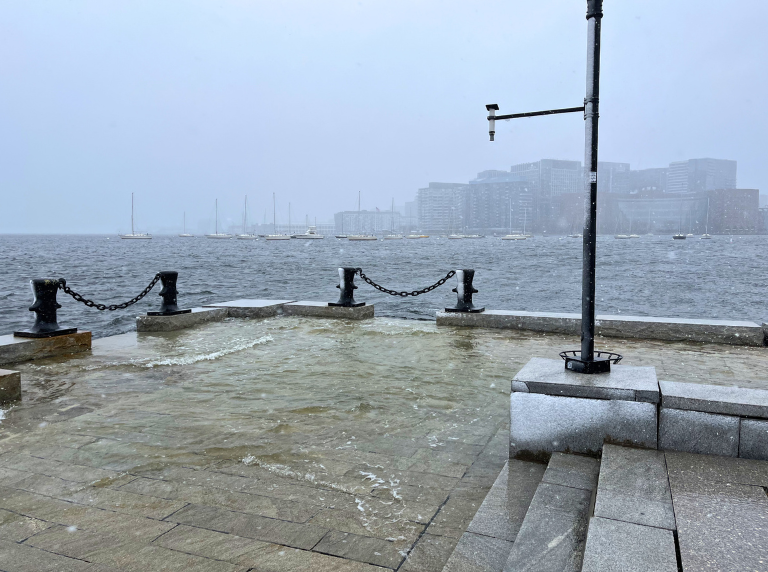
The Stone Living Lab’s Real-time Monitoring Network includes flood sensors, tide gauges, wave buoys, and weather stations that provide real-time data on conditions in Boston Harbor and beyond. In 2026, this network expanded to include 10 additional overland flood sensors in towns and cities along the Massachusetts coast, and 2 new wave buoys in Buzzards Bay and the North Shore. Upon completion of the expansion, the network will consist of a total of 26 instruments.
The network collects data on water levels, waves, and weather conditions, allowing researchers to track real-time conditions and evaluate how coastal conditions shift due to storm events and climate change. The project provides a continuous time series of metocean data which can be viewed by local and state partners, researchers, and the public in our Real-time Monitoring Dashboards, supporting day-to-day decision-making as well as long-term planning.

Background
Monitoring is the regular observation and recording of parameters related to our environment and provides us with a better understanding of changes in natural conditions over time through collecting and analyzing data. Real-time monitoring of tides, wave conditions, overland flooding, storms, and more, provides critical information to improve coastal models, inform flood resilience planning, prepare neighborhoods for storms, and update emergency response teams.
The Real-time Monitoring Network’s instruments provide vital online data to local and regional governments, the public, and other researchers to support evidence-based decision-making. Instrument installation sites were strategically selected based on observed flooding, the Massachusetts Coast Flood Risk Model results, and input from local partners. This project is managed in partnership with Woods Hole Group, the City of Boston, and several municipalities across Massachusetts.
Research Objectives
This project aims to increase confidence in resilience measures and build public support for nature-based coastal resilience projects and improve local capacity to prepare for and reduce impacts from extreme coastal storms. Another goal of this project is to disseminate metocean data to enhance public awareness of often unseen extreme flooding events.
Schedule
Expansion of the monitoring network is expected to be completed by Summer 2026.
Updates
The Stone Living Lab publishes Real-Time Monitoring Field Observations with data collected from the network following weather events. Check out our News page for recent updates.