Experiential Learning in Boston Harbor: A Week with the SLL Teacher Institute!
By Daria Healey, Stone Living Lab Summer Teacher Institute Fellow
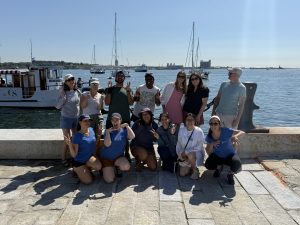
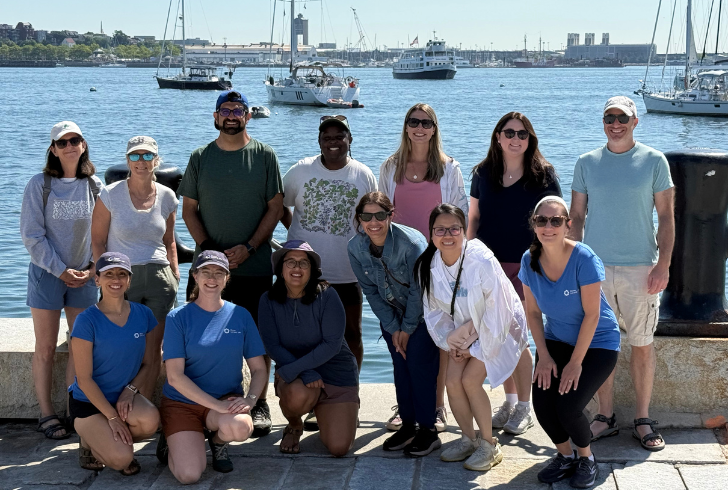
Last month, the Stone Living Lab welcomed ten new educators to our fifth annual Summer Teacher Institute. What an amazing five years it has been, bridging principles of place-based learning and participatory science with environmental educators, researchers, and advocates across the Greater Boston community!
This year’s cohort included public school teachers and curriculum supervisors specializing in subjects across the sciences and humanities, working with students from middle school to adulthood. Over the course of this free, five-day program, the teachers combine what they learn in classroom and field-based experiences to develop their own place-based lesson plan addressing social and/or ecological facets of climate change, which they can implement in the following school year.
This year’s program was co-facilitated and developed by Holly Rosa-Watson (Boston Public Schools – BPS), Rebecca Shoer (Stone Living Lab – SLL), and Daria Healey (SLL).
Follow along to see what we explored each day!
Kicking off the week at the Commandant’s House in the Charlestown Navy Yard, we introduced the teachers to the core topics of the Institute: place-based learning, participatory science, and climate change.
National Park Service (NPS) Director of Education Celena Illuzzi discussed the role of NPS in providing educational opportunities for youth and families across Boston Harbor, introducing the six core pillars of place-based learning. These pillars establish learning objectives that are rigorous, real, empowering, collaborative, integrated, and grounded in place. We connected and built upon these pillars throughout the week.
After Celena’s introduction, we led a presentation discussing the social and ecological climate change in the context of Boston Harbor, before we pivoted to one of our favorite events of the week: the Protocol Carousel!
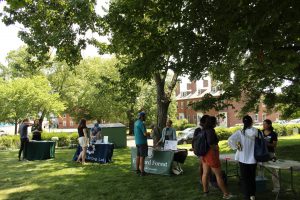
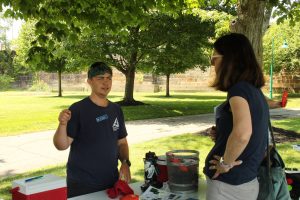
As part of the Carousel, we partner with Boston-area educators and researchers to introduce a wide variety of participatory science protocols used within their own organizations. They connect with the teachers one-on-one to discuss how their protocols could be applied within the teachers’ specific grade levels and topic areas.
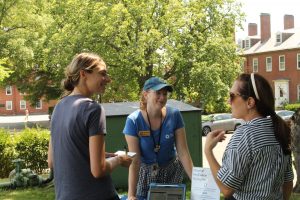
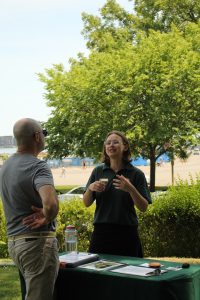
A full list of partner organizations and their participatory science protocols are included below:
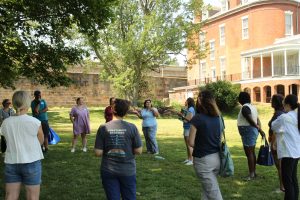
As we moved into the second day of the Institute, the teachers considered how the principles and protocols that were introduced earlier could actually be connected and applied within the classroom. To do so, we were joined by three wonderful alumni of the Teacher Institute, who discussed the lesson plans that they implemented with their own students! It was incredibly impactful to hear from them directly and learn about their journeys navigating the challenges and opportunities of building new material into their curricula.
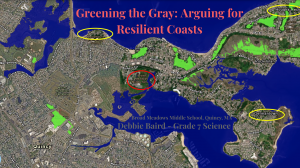
Debbie Baird (2022 Institute cohort) described a lesson plan from this past school year in which her 7th grade science students investigated the impacts of sea level rise and collaborated to design materials advocating for the implementation of their own nature-based solutions.
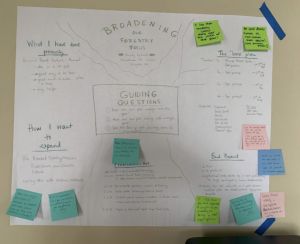
Emily Kotwal’s (2023 Institute cohort) high school Environmental Technology students used protocols developed through two Harvard Forest programs, Our Changing Forest and Buds, Leaves, and Global Warming, to monitor long-term change in a forested region of their school campus.
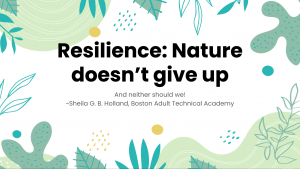
Sheila Holland (2025 Institute cohort) described the process of revising her lesson plan as she encountered new challenges, eventually coming to a project that engaged her adult students in the process of building and tracking the progress of their own marine drifter throughout the Atlantic Ocean.
In the afternoon, we joined Erin Kelly and Kim Baker at the Boston Nature Center (BNC) in Mattapan. This was our first time visiting the BNC as part of the Institute, and it did not disappoint! We explored trails, community gardens, and meadows across the 67-acre wildlife refuge.
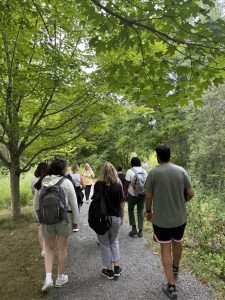
Along the way, Erin and Kim demonstrated tools and techniques that the teachers could use in their own outdoor education, including nature journaling, scientific drawings, and simplified species identification. They also emphasized the importance of not simply providing answers for students when in nature. Instead, we can encourage exploration and learning by asking students to make observations, ask questions, and investigate their own predictions and connections. As Erin said, “Sometimes we fall into a pattern of thinking all of science has been discovered already – this is not the case!”
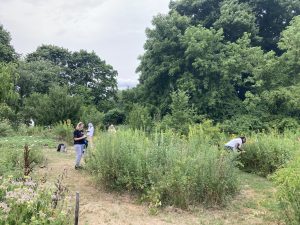
On Wednesday, we started our morning with additional members of the Stone Living Lab team at the Condor Street Urban Wild in East Boston. After a tour and discussion about the history of Condor Street, the teachers worked on a park design activity, thinking about how the needs of humans and other species might coexist and be met within parks and other green spaces.
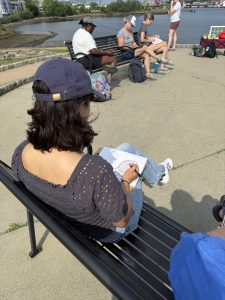
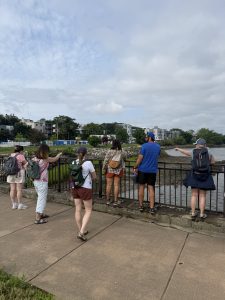
Holly also led a community asset mapping exercise to think about how we can identify different types of resources available within a space.

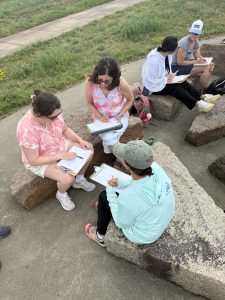
Then, Liana Greenberg-Nielsen (SLL Education and Engagement Program Coordinator) and Monica Wheeler (SLL Climate Education and Program Intern) led us down to the water, where we learned about North America’s first installation of Living Seawalls panels!
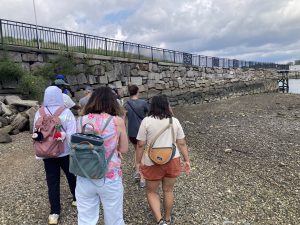
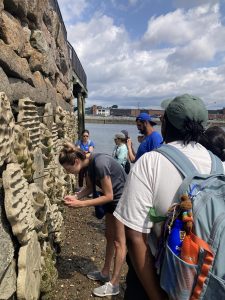
As part of a collaboration between the Stone Living Lab and Living Seawalls, this installation was designed as a pilot for investigating how we can help marine biodiversity thrive in urban coastal environments, with panels that mimic conditions of natural ecosystems.
After a lively morning outdoors, we returned to the Commandant’s House for the afternoon, where we introduced the teachers to the three P’s of place-based planning: place, protocol, and partner. This served as the foundation for the afternoon activity, where the teachers took their first dive into developing material for their capstone project and identified their three P’s. They also shared their ideas in a “speed dating” activity for additional feedback and revision.

With just two days left in the Institute, we met on Thursday morning at Carson Beach in South Boston. To set the stage, we began by building expectations matrices, in which the teachers think about how to apply classroom expectations within outdoor settings.
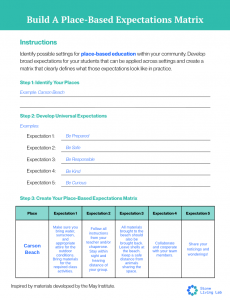
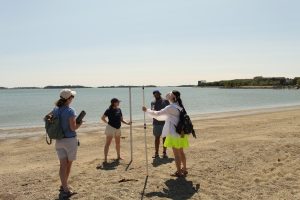
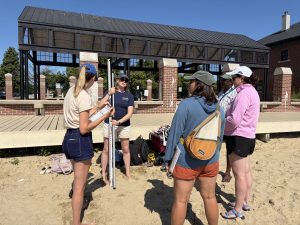
We then explored three participatory science protocols along the beach, including beach profiling, marine debris tracking, and a coastal bioblitz using iNaturalist.
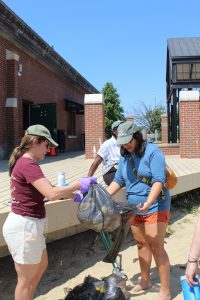
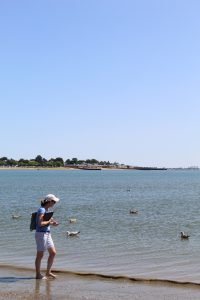
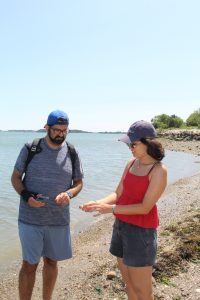
In the afternoon, the teachers put marker to paper to showcase their lesson plans in a Gallery Walk. The teachers perused the lesson plans at their own pace and provided written feedback with affirmations, questions, and suggestions. We left the Navy Yard feeling strong about the directions of our projects and ready for our final day together!
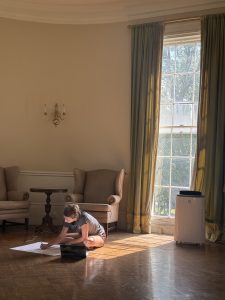
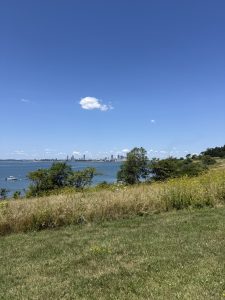
We celebrated our last day together by starting at the Leventhal Room in the Boston Harbor Hotel. Here we eased into the morning by journaling while listening to a chapter from Dr. Robin Wall Kimmerer’s 2015 bestseller, Braiding Sweetgrass, before making our way to Long Wharf to spend the rest of the day on Spectacle Island!
NPS ranger Amelia Benstead met us on the island to give us a tour and discuss Spectacle’s distinctive history, from glacial formation during the Ice Age to today. Humans have interacted with the island for thousands of years, from local Indigenous communities to European settlers. Across time, Spectacle has served many purposes to humans, some of which had significant harmful environmental impacts, prompting large-scale restoration efforts through the 1990s. Spectacle re-opened to the public in 2006, offering hiking, swimming, wildlife watching, and coastal relaxation just minutes from the city.
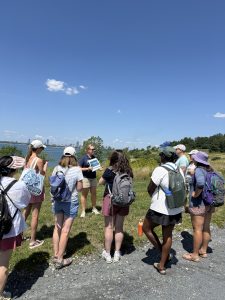
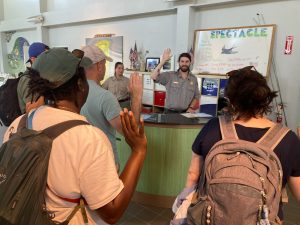
After some open exploration during lunch time, we wrapped up the day by swearing in all of our teachers as Junior Park Rangers, complete with ranger badges and Buddy Bison stuffed animals. We then returned to Boston, ready to take on our final capstone assignments!
The teachers are now hard at work putting the final touches on their capstone projects before presenting their plans to the rest of their cohort and Institute partners at the end of August.
We are so grateful for the time we got to spend with our teacher cohort this week and for our wonderful partners who made this work possible. We look forward to seeing these lesson plans in action for the coming school year!