From Salt Marshes to Living Seawalls: Reflections from the Coastal Nature-Based Solutions Workshop in Cork
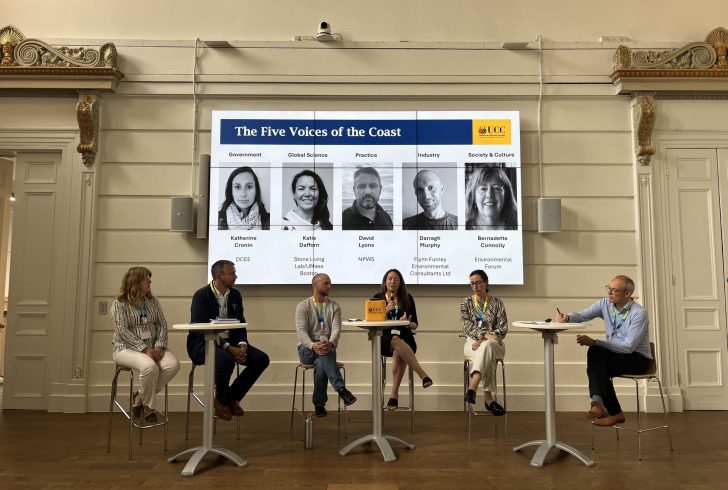
by Katie Dafforn
In June, I had the opportunity to participate in the Coastal Nature-Based Solutions: Restoration, Hybrid Infrastructure and Implementation workshop hosted by Louise Firth at University College Cork (UCC). Louise is a valued member of the Stone Living Lab Scientific Advisory Committee. The workshop brought together researchers, practitioners, policymakers, and community leaders from across Ireland and beyond to discuss the evidence, implementation pathways, and practical challenges associated with coastal nature-based solutions (NbS).
The workshop opened with discussions on coastal hazards and exposure. Researchers presented a new Coastal Exposure Index for Ireland designed to quantify climate hazard exposure and evaluate the protective role of natural habitats. The work highlighted how different coastal ecosystems contribute to risk reduction, while also identifying areas currently exposed to coastal hazards.
Several speakers emphasized the importance of screening tools that can help prioritize locations where nature-based solutions may provide the greatest benefit. Advances in LiDAR, national elevation datasets, and tidal records are enabling researchers to identify areas with the greatest potential for habitat restoration and future marsh migration.
Salt marshes featured prominently throughout the workshop. Researchers described ongoing efforts to better understand marsh condition, restoration potential, and carbon sequestration across Ireland.
New analyses suggest that Irish salt marshes store substantial quantities of blue carbon, with estuarine marshes accounting for much of the total marsh area and carbon stock, while fringe marshes contain disproportionately high carbon densities. Presentations also highlighted work to identify opportunities for creating new pioneer marsh habitat and restoring degraded systems using national-scale elevation and tidal datasets.
A recurring message was that restoration requires understanding both present-day marsh condition and future trajectories under sea-level rise. Several speakers emphasized that nature-based solutions must be planned with long-term adaptation in mind, ensuring restored habitats can persist and migrate as environmental conditions change.
The BRICONS (Building Resilient Irish Coasts through Oyster Restoration) project explored how native oyster reefs may function as nature-based solutions within ports and harbors.
Researchers reported encouraging early results from oyster reintroductions. Both adult and juvenile oysters have demonstrated good survival and growth, with condition indices comparable to source populations. At the same time, the project is investigating the broader ecological benefits that restored reefs may provide, including biodiversity enhancement, sediment stabilization, water quality improvements, and climate adaptation benefits.
The work extends beyond ecology. Researchers are conducting engineering studies in wave flumes to understand how restored reefs alter hydrodynamics and coastal processes, while stakeholder workshops and permitting efforts are helping prepare for larger-scale implementation.
Another presentation focused on horse mussel (Modiolus modiolus) reefs, one of Ireland’s least understood marine habitats.
Although horse mussels remain widespread as a species, the complex reef habitats they create have become increasingly rare. These reefs support rich biological communities and provide habitat for commercially important species including scallops and crabs. Researchers are combining field surveys, fisheries knowledge, industry records, underwater video, and genetic connectivity analyses to better understand their distribution and condition.
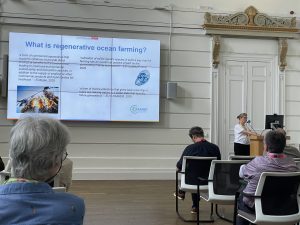
Presentation on regenerative ocean farming.
Several presentations explored how aquaculture can contribute positively to marine ecosystems.
Researchers participating in the Cool Blue Future initiative are investigating regenerative ocean farming approaches that integrate seaweed cultivation with broader ecosystem objectives. Discussions focused on whether kelp farms can function as nature-based solutions by contributing to biodiversity enhancement, nutrient removal, and carbon capture. Researchers also highlighted the need for stronger evidence regarding the ecosystem services provided by seaweed farms, particularly under real-world farming conditions.
The AGORA project told an inspiring story of Harper’s Island Wetlands in County Cork.
Over more than two decades, what began as the efforts of just two community members evolved into a thriving nature reserve supported by local volunteers, schools, and conservation groups. Community-led initiatives have included constructing bird hides, restoring habitat, creating nesting sites for sand martins, and managing invasive vegetation.
Researchers emphasized that successful community-led restoration requires more than enthusiasm. Clear governance structures, defined roles, practical early actions, and
sustained engagement are all essential ingredients. The lessons emerging from Harper’s Island are now being shared across Ireland, Portugal, Norway, and other regions seeking to scale community-driven conservation efforts.
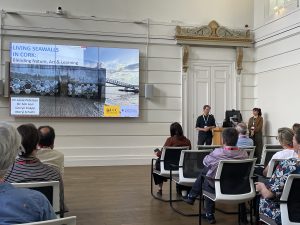
Presentation on the Living Seawalls in Cork.
The workshop also explored opportunities to better integrate ecology into coastal infrastructure
Presentations on Living Seawalls in Cork examined both the ecological and social dimensions of retrofitting seawalls with habitat-enhancing features. Conversations highlighted the importance of public engagement, particularly in addressing concerns about how ecological enhancements might affect existing infrastructure uses.
Another project, BlueShores, is testing hybrid approaches that combine natural and engineered elements, including wood fascines, oyster gabions, and three-dimensional habitat structures. Researchers are combining field monitoring, drone surveys, hydrodynamic measurements, biodiversity assessments, and future climate modeling to evaluate performance under changing conditions.
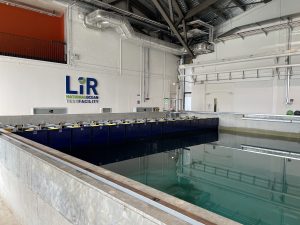
The Lir National Ocean Test Facility for laboratory testing of offshore wind, wave and tidal energy devices.
On the second day of the visit, I had the opportunity to meet with researchers from University College Cork’s Department of Geography and the Department of Planning and Sustainable Development, as well as researchers from the MaREI Research Centre, one of Ireland’s leading centers for climate, energy, and marine research. Discussions explored the intersection of coastal resilience, spatial planning, nature-based solutions, and climate adaptation, highlighting the importance of integrating ecological, engineering, and social perspectives when designing interventions for coastal communities.
The visit also included a tour of the Lir National Ocean Test Facility, which is a custom designed test facility for laboratory testing of offshore wind, wave and tidal energy devices.
Another highlight was visiting the two UCC Living Seawalls installations in Ringaskiddy, adjacent to the UCC Beaufort Research Laboratory, and in Cobh. These installations form part of a growing international effort to enhance biodiversity on marine infrastructure by incorporating habitat complexity into seawall design. It was exciting to see how Ireland is adapting and testing approaches that have been implemented around the world, while also generating place-based evidence on ecological performance, social acceptance, and pathways to implementation within local regulatory and environmental contexts. The visits provided a valuable opportunity to exchange lessons learned between the Cork and Boston programs and to discuss future opportunities for collaboration.
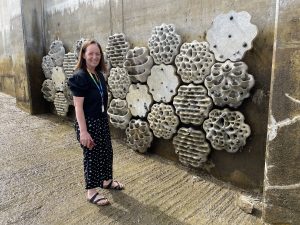
Dr. Louise Firth standing in front of one of the Living Seawalls at Ringaskiddy.