Meet the Interns: Monica Wheeler
What brought you to the Lab and what do you hope to gain from this experience?
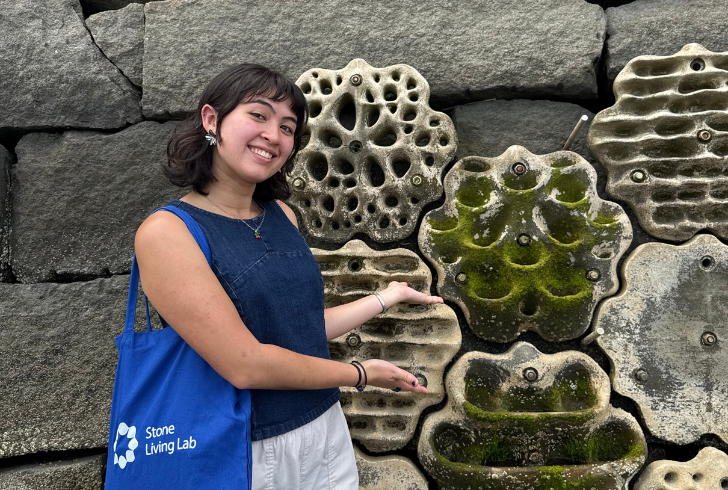
Hello! My name is Monica and I’m the Stone Living Lab’s Climate Education and Program Intern. This spring, I graduated from Williams College where I studied biology and conducted research in marine sciences, archival history, and engaged with conservation education.
During my first internship, I conducted social justice archival research to generate educational resources to highlight marginalized Asian-American history local to the college. Afterwards, I continued community engagement through my part-time job designing science lessons for elementary students. Then, I applied the curriculum-building skills I learned from both of these settings–social justice content design and STEM education–to design and facilitate a temporary and interactive museum exhibit on coral reef conservation during my research internship at the Smithsonian National Museum of Natural History. This experience really deepened my interest in public conservation education programming through interactions with wide visitor audiences.
My current role at the Stone Living Lab closely ties together my background in nonprofit operations, community engagement, and marine biological research to promote environmental education around Boston! It has been particularly rewarding to center place-based nature education and see how much new knowledge people might discover about the spaces they frequent, and to remind learners of our connection to natural environments, even in the city.
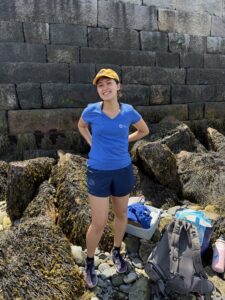
Monica at Georges Island during one of Dr. Aly Putnam’s sampling trips for a climate resilient seaweeds research project.
Tell us a little bit about your internship.
As part of the SLL Education Team, I work primarily with Liana Greenberg-Nielsen, Rebecca Shoer, and Daria Healey, and collaborate with Boston Harbor Now, the National Parks Service (NPS), the Department of Conservation and Recreation (DCR) staff and the Stone Living Lab team at UMass Boston.
So far, we have piloted a number of new climate education activities, including a climate personality quiz and postcards. One major goal of the projects we are creating is to spark meaningful conversations about climate change by inspiring hope, awareness, and ultimately action through creative means. We emphasize that confronting climate change requires help from all different kinds of people with diverse skills and perspectives: everyone has something to contribute. I find this framework really effective in approaching such a challenging topic like climate change that people can sometimes feel discouraged and less likely to engage. For example, we designed the climate personality quiz cards and postcards with that critical facilitator-visitor interaction then leaving the visitor with open-ended room to get creative with how they complete the activity through an easily shareable medium. We also bring our Climate Carts, the interactive environmental science modeling activities we’ve created, to our weekly Science in the Park programs on Spectacle Island: this is a good example of how our partnerships (in this case with the NPS) expand the reach of our education to wider locations and audiences.
What’s next for you?
I’m planning to apply to a Ph.D. program in coastal engineering or marine biology in the next year, and I hope to integrate conservation education into my project and throughout my future career in science. In the fall, I’m looking for opportunities to continue working on ecosystem restoration in laboratory settings and research-based climate resilience around Boston Harbor. Learning about the history and ongoing challenges in the Harbor during this internship has inspired me to keep pursuing positive growth for the city’s communities and coastal infrastructure.
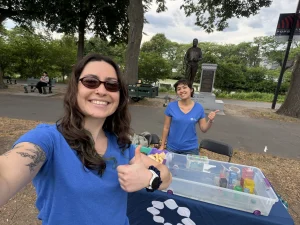
Monica and Liana tabling at the Charles River Esplanade for GroundBeat.
Do you have a favorite experience you’d like to share?
An especially memorable experience for me was my first time tabling as a member of the Lab with Liana at the Charles River Esplanade for the GroundBeat event. We brought our Rising Sea-level City Climate Cart and interacted with tons of visitors during the Salsa at the Shell performances which included professional band members as well as a youth band. During the musical performances, as the audiences enjoyed the beautiful warm weather, danced to music, and kids frolicked in the grass, I felt very fortunate to be a part of the staff and contribute to such a wholesome event. This was also the first experience where I had to really think on my feet about how to best communicate climate science to visitors of different ages, and the work always feels very fulfilling knowing that even small interactions can leave lasting impressions on people.