Summer Partnership Programming with Boston Harbor Now
By: Rebecca Shoer
Boston Harbor Now is one of the core partners of the Stone Living Lab, helping to bring together the five signatory organizations to launch this unique organization in 2020. BHN’s work focuses on the whole harbor, connecting communities, waterfront, and islands to advance a shared vision that is safer from rising seas, more welcoming to everyone, and a driver of our region’s health, economy, and quality of life. This summer, BHN programs staff came together with the SLL education team to develop and pilot three new climate change programs that combined our shared values of place-based education and community.
Using the results of a 2025 programming analysis by 2025 BHN summer fellow Sarah Ferriter, we focused our efforts on specific locations where we haven’t worked before, or where our community partners particularly ask for climate programming. We then asked ourselves: who is our audience for these pilot programs? What are our educational goals? We also framed our work through the lens of the “ladder of engagement” to help move individuals from awareness, to connection, to action.
Climate change is an incredibly challenging topic to engage with folks about. Its scale is tremendous, and at its core is a deeply existential dilemma: can humans live with our planet in a just and sustainable way? Talking about things like sea level rise or carbon emissions can also cause someone to feel shame or fear – turning them away from a learning opportunity. It can be tough to ask someone enjoying a summer stroll on the Harborwalk to grapple with the dilemmas presented by climate change!
As a group, we knew that we wanted to create activities and talking points that welcomed visitors into a space and experience, presenting climate change as an opportunity for communities to come together and imagine new ways of being on our planet. We also took inspiration from the work of the Yale Program on Climate Change Communication and Dr. Ayana Elizabeth Johnson, creating spaces where visitors could practice talking about climate change and also identify how their own individual strengths can help their own communities and the planet.
Keeping all of these goals in mind, our team developed and piloted three new activities around Boston:
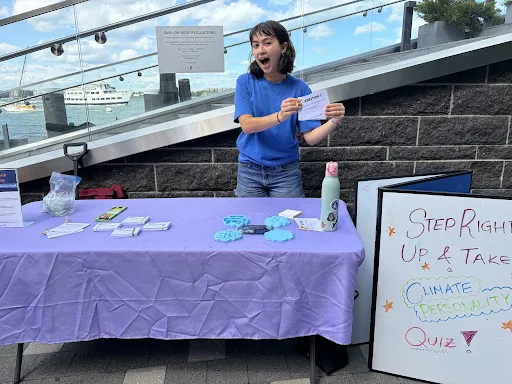
Climate change is a big challenge – perhaps the biggest one our planet has faced. We need each and every one of us to bring our unique skills and strengths to help! This fun and short personality quiz helped participants identify whether they were a Creative, Mediator, Gatherer, or Planner. Once they discovered their Climate Personality, they took a pledge of how they will use their unique skillset to help address climate change. You can take the quiz yourself online here!

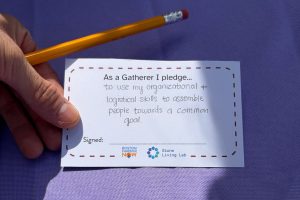
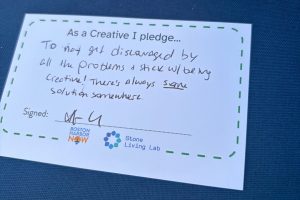
Two pledges taken by program participants! Left: “As a Gatherer, I pledge to use my organizational + logistical skills to assemble people towards a common goal.” Right: “As a Creative, I pledge to not get discouraged by all the problems + stick w/ being creative! There’s always some solution somewhere.”
One of the biggest challenges about climate change is that we don’t talk about it with each other! Inspired by our Climate Conversation Cards, we designed four unique postcards with prompts encouraging folks to share their thoughts about Boston’s future, or how they personally take action for their environment. Over the course of the summer we mailed out 50 postcards from program participants.
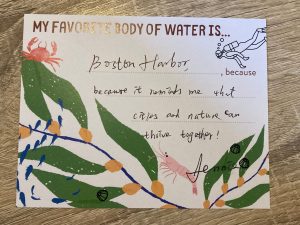
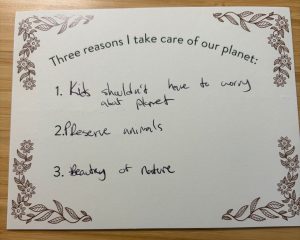
Two postcards that were filled out by participants! Each postcard that was filled out this summer was mailed out.
This summer, the US Army Corps of Engineers released a draft multi-year study with recommendations for Boston to adapt to sea level rise. Most importantly, the City needed to engage as many residents as possible in this process and collected community input about the study, and we partnered with the City to share information about this project and help folks share their input! Our team developed tabletop models of the different strategies that the Army Corps study suggested, and collected votes about what kinds of strategies folks most preferred. We particularly encouraged folks to think about nature-based approaches, as opposed to relying on seawalls or levees as the only feasible protection strategies for our city.
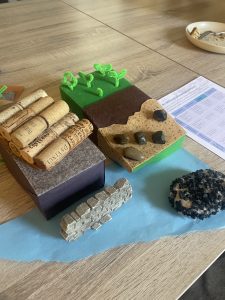
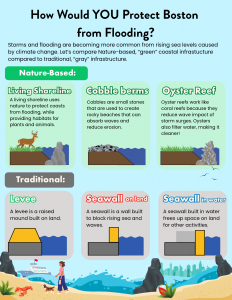
A tabletop model of different sea level rise protection strategies as discussed in the USACE draft study (left) and a poll prompt asking folks what kinds of flood protection strategies they prefer (right).
We piloted each of these activities two times across six different events around Boston, including:
After a summer of programming, the combined BHN and SLL team is now hard at work reviewing the data and information that we collected from these activities. It’s clear that folks are eager to talk about climate change when a space is joyful and welcoming – many times we discovered people needed a place to air out their emotions before starting to think about solutions. We also discovered that people fall back on tried-and-true environmental actions like recycling or picking up trash when creating their action pledges, rather than actions like advocacy or joining community organizations.
As we look to future programming together, our team will work to identify and share specific ways folks can make change in their own communities, from attending zoning board meetings to calling specific political offices. How can we help make members of the public more comfortable with these kinds of actions? Or how can we be sure we represent their voices in our own work? This winter we will be hard at work answering these questions, and will be ready with new and adapted activities for 2027!
A huge shout out and thank you to all of the folks involved with this team this summer: Jason Rundle, Jaye Meakem, Joe Christo, Kinsey Mustafah-Widberg, Levi Chen, Liana Greenberg-Nielsen, Linda Orel, Monica Wheeler, Nick Pioppi, Rebecca Smerling, and Rebecca Shoer. Stay tuned!