Northeastern, MassBays, and Urban Harbors Institute come together with Stone Living Lab to share emerging research
by Katie Dafforn
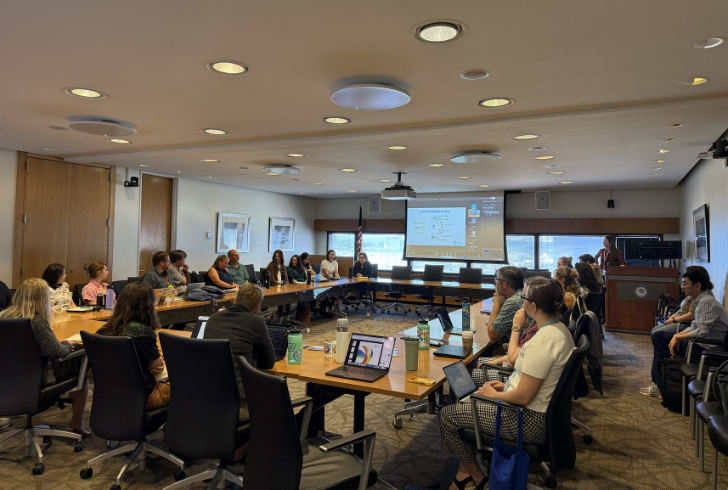
The Stone Living Lab welcomed researchers, educators, and practitioners from Northeastern University, the MassBays National Estuary Partnership, and the Urban Harbors Institute for a workshop at UMass Boston in June.
The workshop brought together more than 30 participants representing a diverse range of disciplines, from marine ecology and environmental engineering to science education, community engagement, and coastal planning. The goal was simple: share emerging work, identify opportunities for collaboration, and build stronger connections among organizations working to improve the health and resilience of Massachusetts coastal ecosystems.
A major focus of the workshop was the future of coastal habitat restoration and the challenge of ensuring restoration projects remain effective under changing environmental conditions.
Randall Hughes from Northeastern University shared work investigating assisted gene flow in eelgrass restoration, exploring whether populations adapted to warmer conditions may help eelgrass meadows remain resilient as ocean temperatures rise. The work also examines the social dimensions of conservation, including barriers to adopting conservation moorings and opportunities to better align restoration strategies with community needs.
Jill Carr from MassBays then shared about extensive eelgrass monitoring and restoration efforts across Massachusetts. In addition to statewide mapping programs, the partnership is advancing seed-based restoration techniques, investigating interactions between aquaculture and eelgrass habitats, and expanding capacity for climate-resilient restoration practices. Current restoration efforts span multiple sites and are helping build the knowledge and infrastructure needed to scale eelgrass recovery across the region.
Stone Living Lab researcher Aly Putnam described efforts to identify climate-resilient populations of habitat-forming seaweeds along the Northeast coast. By studying populations from Maine to Virginia, the project is investigating whether some seaweed populations possess greater tolerance to warming temperatures and extreme heat events. The research combines population genomics, laboratory thermal tolerance experiments, and policy analysis to inform future restoration and management efforts.
Kelsey Schultz (Mass Oyster Project/Northeastern) and Michael Tlusty (School for the Environment, UMass Boston) also discussed oyster restoration initiatives and the links to aquaculture as well as the importance of understanding how public perceptions and social values influence restoration outcomes. Several conversations highlighted the growing recognition that ecological success in restoration also requires regulatory, cultural, and community considerations.
The workshop featured a range of innovative monitoring programs that are helping researchers better understand ecosystem health and environmental change.
Northeastern University’s Jen Bowen presented research using microbial source tracking techniques to identify sources of fecal contamination in Plum Island Sound. Working closely with shellfish harvesters, municipalities, and state agencies, the project combines community science, molecular techniques, and machine learning to improve understanding of water quality and support informed management decisions.
Stone Living Lab researcher Francesco Peri introduced a new framework for assessing salt marsh health. Using Thompson Island proposed as Cathleen Stone Island as a case study, the team is applying a diagnostic approach that measures key indicators such as tidal range, drainage patterns, flow dynamics, and marsh elevation to help determine appropriate restoration actions. The work emphasizes that effective restoration begins with understanding the underlying causes of ecosystem decline.
Shannon Hogan from the Urban Harbors Institute shared work examining microplastics in green infrastructure systems and community science approaches for tracking marine debris in urban waterways. Through partnerships with students and volunteers, these projects are helping document how debris moves through watersheds and identify opportunities for long-term monitoring and mitigation.
Mark Borelli and Joe Christo from the Stone Living Lab then highlighted available monitoring technologies and resources, including autonomous vessels, drones, bathymetric mapping tools, and a rapidly expanding real-time monitoring network. The network now includes wave buoys, tide gauges, a meteorological station, and overland sensors distributed across coastal Massachusetts, providing valuable information on flooding and coastal conditions.
Jarrett Byrnes shared findings from the first generation of Living Seawalls installations at Fan Pier in the Seaport District and Condor Street Urban Wild in East Boston. These habitat-enhancing panels are designed to add structural complexity to otherwise flat seawalls, creating conditions that better support marine biodiversity.Early monitoring results suggest that panel design, intertidal elevation, and exposure to extreme conditions all influence ecological outcomes.
A recurring theme throughout the workshop was the importance of transforming scientific data into practical tools for communities, planners, and decision-makers.
Prassede Vella and Jill Carr from MassBays presented their TIDEGateway tool and associated work, which provides information on tide gate infrastructure across the region and helps identify opportunities to improve habitat connectivity while maintaining flood protection goals. The project combines ecological assessments, infrastructure inventories, and stakeholder engagement to support restoration planning and implementation. They also explored how citizen science, educational tools, and data management systems can strengthen environmental monitoring and expand public participation in coastal stewardship.
Katie Zarada from the Stone Living Lab shared updates on the development of new data products and dashboards designed to make research findings more accessible to both technical and public audiences. These include real-time flooding and coastal conditions dashboards that bring together monitoring data from across the region.
Daria Healey from the CORE Lab at Northeastern is investigating how students think about the relationship between people and nature. Working with more than 500 students across eight schools, the research explores how environmental education can strengthen systems thinking and help students recognize both the challenges humans pose to ecosystems and the positive role people can play in creating sustainable futures.
The final session focused on climate adaptation and long-term coastal planning.
Allison Novelly and Kristin Uiterwyk from Urban Harbors Institute discussed harbor planning processes, community engagement strategies, and their work on managed retreat. Conversations emphasized the challenges communities face when making decisions about future flood risks and the emotional dimensions of climate adaptation.
Stone Living Lab’s Paul Kirshen introduced Dynamic Adaptive Policy Pathways, an approach that helps communities sequence adaptation actions over time while accounting for uncertainty. Rather than committing to a single large investment today, the framework encourages incremental actions that preserve future options and allow strategies to evolve as conditions change.
The discussion highlighted a central challenge in climate adaptation: making decisions today that remain effective under multiple possible futures.
The workshop concluded with breakout discussions focused on three key topics: how metrics collected through experiments and monitoring can be translated into performance standards used by regulators, insurers, and infrastructure practitioners; how community knowledge, perspectives, and experiences can inform research and implementation; and how planning and data tools can be designed to better meet community needs.
Participants emphasized the importance of developing meaningful thresholds from monitoring data, leveraging advances in data processing and artificial intelligence, and exploring opportunities for collaboration around water quality monitoring, oyster restoration, and tide gate management. Discussions on community engagement highlighted the need to build trust-based relationships, recognize local expertise, avoid engagement fatigue, and work closely with community-based organizations to co-develop research and solutions. Participants also noted that effective decision-support tools must be tailored to their intended audiences, tested iteratively with end users, and designed to accommodate different levels of technical capacity.